Wednesday, February 20, 2013

Tokens of love?

Most families have a few trinkets that have survived the years, often without the accompanying background story. Here are a couple of ours.


Chinese coin:

This is a Hu Poo 20 cash coin dating from around 1903-1905. Not particularly rare and not valuable, I understand, but how did it end up in suburban Bristol?


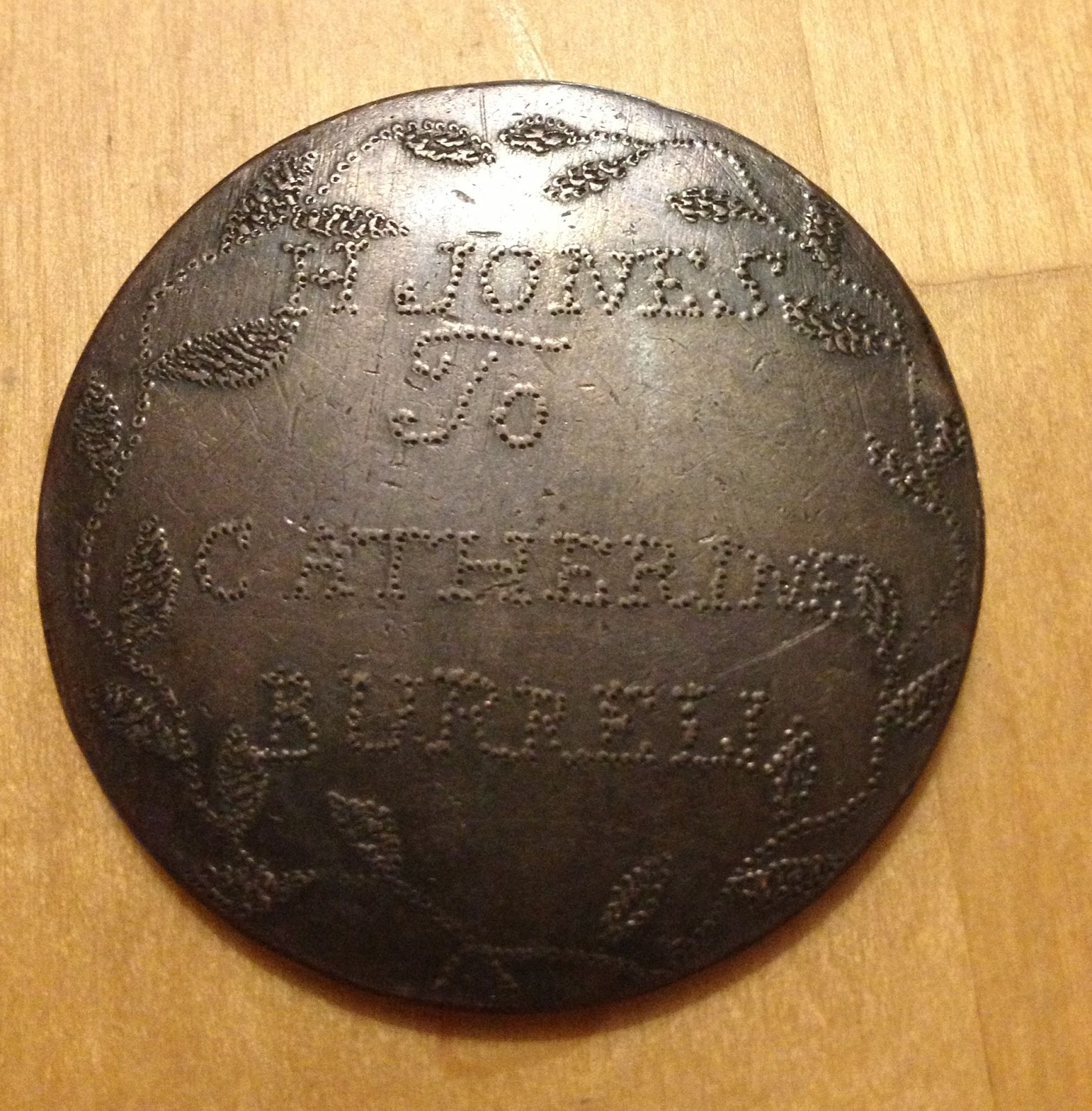
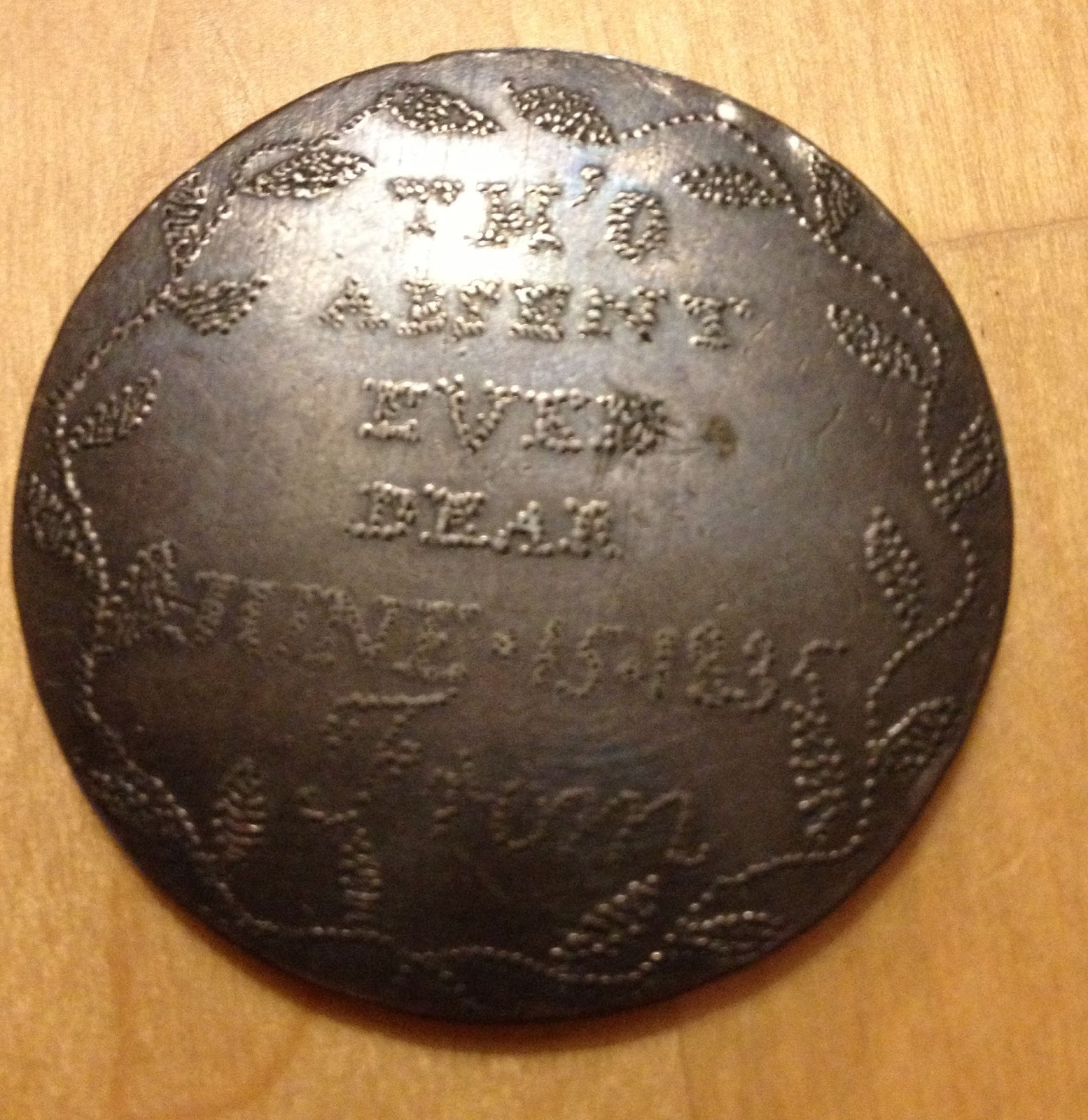
Engraved token:

This token, inscribed "Th'o absent ever dear - June 15 1835 - from H Jones to Catherine Burrell" might, at first glance, be easier to explain. But to date we haven't found a link to a Catherine Burrell nor an H Jones. Presuming that Catherine was an adult in 1835, she may have been sister, aunt or other relation to my 2xgt grandfather James BURRELL (born in 1826), but since the token was passed into our branch of the family, I think it unlikely that she had children of her own.

The two coins might, of course, not be linked at all, but they both seem to originate from our Burrell ancestors. I'm aware that 1835 was an era when missionaries were being expelled from China. My 2xgt grandfather, James BURRELL, had an elder brother George who was a Baptist Minister, and the family were strongly linked with the church, so perhaps there's a missionary connection there. Any ideas welcome!!


Saturday, January 19, 2013

An Unhappy Woman, and a Maritime Connection

My paternal grandmother's ancestors were always something of a mystery to me, as she talked very little about her family, and died when I was young. Talking to other family members didn't help much, as we weren't in touch with her close family, and the furthest I could go using verbal history was her mother, Lilian Lenda CARTER, born about 1889 and probably in Essex. 


Lilian as a young adult

I have never been able to find a birth registration or baptism for Lilian Lenda CARTER. She is variously enumerated on the censuses as having been born in "Hounslow, MDX" and "Onslow, ESSEX". I suspect her given name at that time was simply Lilly as that is how she appears in the 1891 census, where she appears with both parents, Charles Andrews CARTER and Sarah Elinda nee THOMPSON. Lilian's mother, Sarah Elinda THOMPSON, was born in Harwich in 1866, the daughter of Thomas Turner THOMPSON and Elizabeth GARNETT. I am intrigued by the unusual second name, Elinda, and don't know its origins.

Sarah, sadly died in childbirth at the age of 25; her infant son Charles Thomas CARTER survived, and can be found in 1901 living with his paternal grandmother Harriet CARTER in Kent. I can find no trace of him after that. Sarah's young daughter, then simply enumerated as Lily CARTER, is with her maternal grandfather Thomas Turner THOMPSON and the housekeeper Eliza in 1901, whilst her father has remarried and is living with his new family in Dovercourt. I think there was some contact between father and daughter, but Lilian's father had himself had a very difficult childhood and had lost a parent very young.

By 1909, at age 17, Lily had reinvented herself as "Lilian Lenda", (perhaps this was a reference to her mother's middle name Elinda) and was married to 31yr old Albert Edwin THORN, a brewer's clerk from Thetford. It wasn't a happy marriage, although 8 children were born. One of the rare stories my grandmother Irene told about her youth was of being bullied by her 3 older brothers and I understood she was expected to care for her 4 younger sisters - other relatives told me that Lilian 'was often ill and frequently bed-bound'. I suspect that Lilian suffered from severe depression.


Lilian and her first husband Albert Edwin Thorn

Lilian's husband Albert, much older than her, died suddenly of a heart attack at the age of 64. Lilian's children were adult by this time, so she sought work, and as this was during WW2, we know that she spent some time as a nurse.

Lilian as an adult

Lilian later became a housekeeper for a recently widowed James Dale BEAVEN, a businessman. The couple married in 1942, but the relationship remained very much one of householder & servant, and Lilian left him after a few unhappy years. Her last home was with her eldest son, sleeping on his sofa, and the verdict at her inquest was that she committed suicide. She was 59.

Moving back a generation, Lilian's grandfather Thomas Turner THOMPSON was a mariner in his younger years, following in his father George's footsteps -  in fact he was born in Coastguard Cottages at Cromer - but later he worked for the railways as a quay foreman in Harwich. Thomas's wife, Elizabeth GARNETT, came from a large Harwich fishing family and was one of 11 children. They had strong links with the Navy and descendants can be found in several parts of the globe.

Thomas and Elizabeth had 6 children;
Thomas Daniel born 1860, married Alice EVERETT, died 1908
Elizabeth Sarah Ann b 1862, married Edward TURTON, died 1934
Sarah Elinda b1866, married Charles Andrews CARTER, died 1891
Ellen Brown b1870, nothing further known after 1881
Clara Rebecca b1873, nothing further known after 1891
Hilda b1875, died 1897

Elizabeth died in 1889 and Thomas didn't remarry, but is thereafter enumerated with a housekeeper, Eliza JUBY nee NIXON, until his death in 1916.


Friday, October 12, 2012

Crawling backwards, faster

From time to time I check in on the National Archives site to see what's new there. It's an incredible resource although some patience and determined searching is needed to get results, especially if you are researching a common name, or a surname that is also a commonly used word - try BINDING or CATER, for example, and you pull up all kinds of documents which contain those words.

This week, however, I discovered some new leads on my CATER ancestors in Bedfordshire - documents from Leicester & Rutland Record Office have been included since my last visit. They mention my ancestor Andrew CATER, clerk of Elstow, and his wife Alice nee CLARKE, and property in the village of Wrestlingworth. Entering "Wrestlingworth" as a search term gave me lots of CLARKE entries, and cross-referencing these with PRO Wills and parish register transcripts has helped me draw up an extensive CLARKE tree, going back a further 2 generations on Alice's maternal and paternal lines. Alice was my 8xgt grandmother, so these are some of the earliest ancestors in my tree. The Wills and some other documents are downloadable, so I don't even need to rely on other people's transcriptions but can struggle through and make my own!

When I began researching in the 1970's, the only way to gain any information was to travel to the locality and search original documents in dusty record offices. My annual holidays were planned around such road trips, often camping nearby, and washing off the grime of the books before tucking into a picnic. Now so much information is online, even scans of original documents, and networking with other researchers allows those of us who can't travel much the chance to check transcripts against the originals. What might have taken months or years to discover can now be done in minutes, from an armchair at home.

But it's important not to lose sight of the need to check transcripts against original sources, and to look for corroborating evidence. Just because your ancestor had an uncommon name, for example, not everyone with that same name is related! Newer ways of working have cut corners for us, but the method remains the same.

Saturday, September 22, 2012

Mystery and Conflict

One longstanding (25 yrs plus!) brick wall in my research is the relationship between the WYATT and CATER families in Bristol.

In 1714, Thomas WEBB (?-1718) wrote a will in which he described Andrew CATER the younger as his "wife's kinsman", and left him a significant piece of land in Stapleton, Gloucestershire. Mary WEBB (1649-1729), Thomas's wife, was born Mary WYATT, and came from a merchant family with strong London connections. Andrew's ancestors are believed to have had property in both Bedfordshire and London.

The use of the word 'kinsman' implies a more distant relationship than close family - but how distant? And can any further information be found on Andrew CATER - clearly he was the son of another Andrew, and I believe he may have been born about 1661 in Elstow, Bedfordshire. His wife may have been a Mary, but nothing further is known of her.

So far I have found no further clues, except that Andrew CATER named his first son Wyatt CATER, and his grandson was John Wyatt CATER. In fact I have found 17 direct descendants of Andrew who were named either John Wyatt CATER or Wyatt CATER. As for the bequest of land, that only lasted a little more than a generation, as by 1779 it was all mortgaged or sold.


Recently I came across a Probate court case between Andrew CATER and the heirs of Thomas WEBB - and I'm still discovering more about it. The National Archives have provided copies of 4 documents from the case - including the complaint of Andrew CATER, and replies from the widowed Mary WEBB, and from Francis JAY, a nephew of Thomas, who was guardian of Thomas's son (who was declared insane).

Even if this bundle of documents doesn't give the answer, it's another step towards a fuller picture of these families. Another brick in a very holey wall!


Thursday, May 3, 2012


Researching the Binding surname

I have been fortunate to make links over the years with other people researching their Binding ancestry in Somerset.  The name is uncommon, and can also be written as Bindon, Binedin etc.  Surname spellings have only become standardised in the last 100 years or so, and until around 1870 the levels of illiteracy were very high, especially amongst lower income families.The earliest records of my Binding family refer to Robert Binedin and Sarah Tudball's marriage on 9th May 1718 in Chipstable, Somerset.

Church registers are the best (and often only) source of information for that era. We are very fortunate in the UK to have had a well organised system of parish records since the reign of Elizabeth I, and that so many of the registers have survived intact.  Somerset researchers are doubly lucky, as FreeREGtranscribers have already put many of these parish registers online and searchable.  To find which parish registers have been transcribed and where they can be accessed, try Ian Sage's excellent site.

Somerset's Record Office, now known as Somerset Heritage Centre, also holds a wide range of other archives which are of use to the researcher. Maps, Directories, Wills and personal documents of all kinds may be helpful.  My branch of the Binding family were poor labourers, and although I have not found any Wills or documents relating to property for them, they did occasionally come to the notice of the Poor Relief officers and some spent time in the local Workhouses. Some of these documents survive.


For example, Emma Binding (1822-1902) and her husband Ephraim Chandler (1822-1846) fell foul of the Settlement Laws - which would only allow people to receive help from the parish in which they were "settled". When Ephraim fell seriously ill, the family (including a small child and pregnant wife) went to stay with relations in Worle, only to find that they were not eligible for any help from the parish there. The parish overseers forcibly removed them back to Weston Super Mare, where Ephraim was considered to have legal settlement. Both Ephraim and the new infant died within months. Documents recording the legal process and including a statement from Ephraim which tells his life story (which makes very sad reading) survive in the Heritage Centre.

The Workhouses not only provided basic accommodation and food for those who could not support themselves, but also acted as local infirmaries, and several Binding children were born at Axbridge Workhouse, all of them to unmarried women.

 Census returns are available from 1841 onwards, and from 1851 they are very useful as they give birthplace, age and relationship information.  The 1841 census is perhaps the least reliable; ages were (usually) rounded down to the nearest multiple of 5, birthplaces are not given, and relationships not stated. Censuses taken between 1841 and 1911 are available online on various pay-per view and subscription sites, 1881 is freely available on FamilySearch, and the FreeCEN transcribers are working on transcribing the 1841-1871 and 1891 censuses for Somerset. 


Thursday, April 5, 2012

Elsie Selina Burrell - a Servant of the Lord

This transcript of the eulogy appeared in the magazine of Eastville Park Methodist Church, January 1995. Elsie was a lifelong member of this church.

Church magazine, showing drawings of the church through the years

Saturday, January 28, 2012

Wartime Diary

My great aunt Elsie Selina Burrell worked for Cunard in Bristol during WW2, travelling daily from Eastville into the city. This week I came into possession of some diaries she kept at the time.

The diaries are a mix of personal trivia and wider news, recorded often without much emotion. She mentions the Bristol Blitz several times; at one point her office had lost its roof and she worked under a tarpaulin, everything still soaking from the fire hoses. She spent hours in cupboards and in shelters. Traumatised refugees sought shelter in her local chapel, and she mentions washing the hair of a woman dragged from a bombed building.

I don't think we, in the modern world, can really imagine how life was then. The worst of the blitz was in the middle of winter and the bombing at its worst at night. Elsie records with relief the few quiet and undisturbed nights.

Here's a page from her list of air raids, showing the 24th November 1940, the first Great Blitz.


In 1940, Elsie recorded 643 hours of raids. More pages can be seen here: Elsie's diary 1940

I'm planning on including more extracts from Elsie's diaries in the future