Wednesday, February 11, 2026

Memories of WW2 from a child's perspective

Written by Kathleen Mary Lowe (nee Moss) in 2007, in preparation for a visit to the RUH school in Bath. Pupils there were studying life during the War. 

Notes in [brackets] have been added later to give context and further information.

My mother [Dorothy Agnes Moss nee Burrell]) and I had been staying with her cousin who lived about 20 miles away from our home [2 Glen Park, Eastville, Bristol]. Suddenly everyone seemed to be talking all at once. I didn't know what was going on but I new it was something serious. The next thing I remember was being dragged along the street towards the railway station. There was a thunderstorm going on. It was noisy. I was frightened. I was just 7 years old. I asked my mother what war would be like. She said there would be a lot of noise lounder than the thunder that was crashing around us that day. How right she was, 

During the next few weeks life seemed to go on much the same. The grown up people seemd to talk endlessly about war but I didn't understand it. 

In November 1939, two months after war had been declared, we moved to a new house (in Abingdon Road, Fishponds). It was then that things started to happen.

A strange thing called an Anderson shelter was put in our garden. It was made of corrugated steel., sunk in the ground to half its height and the top was covered with about 2 feet of earth. This we were told is where you go during air raids. It was dark and damp and not nice. In the end I spent very little time in our shelter during air raids, but we spent many nights in another Anderson shelter a couple of hundred yards down the road. This one was in my Auntie Doris's garden.

We spent hours sticking strips of paper on our windows. This we were told would help to stop the glass shattering if a bomb fell nearby. At school we were shown how to get quickly but calmly to the air raid shelters. If a raid started suddenly and there was no time to get to the shelter we practised how to "Take Cover" under the desks.

In January 1940 we had a happy event in the family. Auntie Doris had a baby boy, C____. She already had one son Brian who was four years older than me. When C____ arrived I really didn't want to go to school any more. I would happily have stayed home and looked after him but it was not allowed. Auntie Doris's husband Uncle Ron was not there very often. He was a fireman on a stam engine, the man who shovelled the coal. As time went on we saw even less of him as the trains carried high explosives (bombs and shells), they would hide the train in railway tunnels during raids. 

In May 1940 the news came about Dunkirk. This was a tragedy when British troops invaded France and it went wrong. The men had to be got out but it was not easy. We had a message from our relatives in Manchester to say two of our cousins George and Reg [Moss] were among these troops. Hundreds of small boats were used to ferry men back to England. They were taken to parks in different cities where camps were set up to let them rest. Some came to Eastville Park near us. Uncle Ron, Brian and I went ot see if we could find George and Reg. We walked around for a long  time talking to the soldiers, they looked terribly tired and dirty. We did not find our cousins but heard a few days later that they were safe. George had ridden a bicycle with no tyres or brakes to get to the coast. Reg and his friends had found horses and ridden them some of the way. Then when he arrived at the coast he found a rowing boat and ferried some men out to the waiting ships. He went back for more but the rowing boat overturned. We were all so happy they had come home. Before the war ended they were both to see action again, George in Africa and the Far East. 

Meanwhile we used to visit my grandmother and aunties at Eastville. Auntie Elsie was not home very often. She had an important job at the docks. I never discovered qite what it was but I know she sometimes went on ships until they left territorial waters. Then she climbed down a rope ladder into a little boat to get back. When she finished work she often went to a Bristol hospital where she put on her Red Cross uniform and did a few hours voluntary nursing. Uncle George her brother lived in Taunton with his wife Edith. He was a commercial traveller (rep) for a tobacco company. Because of his job he had a car, there were very few cars then. When war started the authorities found out he had been trained as an engineer. He found himself conscripted to work in the aircraft factory in Gloucester. Auntie Edith decided if he was going there she would go too. They rented a couple of rooms and stayed there until the war ended. During this time Auntie Edith found a job in the Bon Marche. It had been a department store but had been taken over and was a packing centre. Auntie Edith spent the war packing food parcels for the troops.

During this time all sorts of changes were being made to the countryside. All sign posts were taken down to confuse the enemy so if you didn't know your way it was just bad luck. All unnecessary lights were put out. Street lights were hooded and really not much use. All houses and buildings had to be "Blacked Out". Dark curtains or shutters used so that no light could be seen from the outside. My mother was kept busy as she had a sewing machine and was always being asked to make curtains. Rationing started and almost everything you needed to buy was rationed at one time or other. Fresh fruit and vegetables were not rathioned but were in very short supply. People were urged to Dig for Victory! Dig up their flower gardens etc to grow food. Coal, the major fuel for heating houses then was rationed.

Mr Day, our neighbour, on leave from the Air Force decided to build a hen house in the garden. He had visions of lovely fresh eggs. Only Mr Day was no DIY expert. He somehow nailed himself inside. His wife eventually heard him shouting to be let out. She called the neighbours to see their new "chicken", they were all helpless with laughter but in the end they got him out by taking the roof off.

By July we were getting some air raids but not a lot of damage was done in the city. It was at this time I realised my father was very ill. He had been in hospital a couple of times but when he came home I thought he was alright. August 12th was my 8th birthday. My Mum said Dad was too ill for me to have friends in the house but she arranged a little party in the garden. Four days later my father died. After this we spent a lot of time with Auntie Doris and family. I was quite happy about this as Brian and I got on well and played with each others' toys. It helped Mum to be with her sister-in-law.

My mother was given a widow's pension. This amounted to 15 shillings (75p) a week. At that time our house rent was 12 shillings and 6 pence. Mum had to get work. Grandpa Moss said he would get her a job at the Aircraft Company [at Filton] as he worked there. I don't think my mother was really ready to start a job, but one morning [September 25, 1940] she set off. As she could use a sewing machine they put her in the fabric department. To waterproof the fabric they used a chemical known as dope [a kind of lacquer]. It smelt awful and gave off fumes that made your eyes run. By lunchtime Mum had decided she could not do this job, She was going home. As she was leaving she talked to one of the girls and told her she was going. the girl tried to persuade her to have lunch first. When they got to the door the sirens went, the girl said to come with her, everyone was heading for the shelter. My mum would not go, there was a bus pulling out and she got on it and came home. We heard later in the day that the shelter at the aircraft works had been bombed. It was a large bomb, I don't think there were any survivors. The bombing had really started.

From then on we had sporadic raids. In November we had some of the worst raids of the war. On the night of the 24th the city centre was altered for ever. The shopping centre, many offices and public buildings were flattened or burned out. The next morning all there was left was smoking ruins. St Peter's church, although just a shell, still stood and is still there today, left just as it was as a memorial. We were not allowed to go into the town for some time so only knew what had happened from pictures.

Although we had not television and at times no radio I didn't miss them, as we had other entertainments. Most weeks we went to the cinema, this was our favourite entertainment in those days. Bristol had about 40 cinemas so there was a good choice. The theatres kept going and there were musicals, variety shows and pantomimes. Food was short and not much variety but I can't remember ever being really hungry. My mother was a good manager, we as children did miss sweet things. We experimented with different sandwich fillings using what was available. Condensed milk was one filling which was popular. I can't remember the others. Bananas were not seen until after the war finished and were quite a novelty when we saw the first ones. Ice cream was another thing that disappeared for years.

We continued to have air raids, mostly at night. A lot of people just slept in the air raid shelters every night, others went to bed and hoped for the best. If the air raid warning sounded they would then get up and go to the shelter. Early in 1941 we heard people talking about evacuation. This meant the children were taken out of the cities where the bombing was really bad and sent to live with foster parents in the country. Brian my cousin and I were told we would be going and asked if we would like to go together. Brian by this time was 12 years old and didn't really like girls, he wanted to go with his school friends. I didn't know what it was all about so didn't have any idea what to expect. In May we were taken to the railway station and off we went. We had no idea where we were going or when we would see our parents again. As it happened we only went about 40 miles [to Taunton]. When we got off the train we all went into a large building, we were given a drink and a bun then we had to be seen by a doctor. I never found out why because I felt fine but I was sent to an isolation hospital. I was kept there for 10 days and was not happy. Then a lady came with a car and took me to a house in the country [Creech St Michael]. My foster parents were Mr and Mrs Counsel, they were really nice. They had a little girl called Pat, seh was just a bit younger than me, we shared a big bed and had very few arguments. Also living in the house were 2 boys, John (Pat's brother) and George who was also being fostered. I went to a lovely little village school. I don't think I learned very much but I enjoyed it. So we spent the summer playing in the fields and was all very peaceful. lBut I did miss home. In August it was my 9th birthday. My mum came to see me for the day and when it was time for her to go home I wanted to go with her. I stayed another week and then my mum came and fetched me home. Bristol was much as I left it except there were more bombed houses.

So it was back to school in September, most of the evacuees seemed to have returned home. We were still getting air raids but less often. Shortages of almost everything continued. The worst was of course food. I never remember being very hungry it was the lack of variety which was hard to take. The winters were very cold and coal was rationed.

One day we were coming home from school and we couldn't believe our eyes. There were strange army lorries coming down the road. They came one after the other in all I believe about 70 of them. The Americans had arrived! They set up camp nearby and for a while became part of our lives. Most of them were very friendly and liked children. Very few children had fathers at home so really enjoyed the Americans playing rounders with them and teaching them how to play baseball. One morning the Americans had gone, there was no warning, no goodbyes, just gone. The air raids had more or less stopped, the obvious signs of war were there, the bombed buildings etc. They would remain for years, even when the war ended the priority was to build new houses, the wreckage of the old ones could wait.

In 1944 our troops invaded France. They were not alone of course, with them were the Americans and lots of others like Australians and Canadians. After a while the news started to get better and people seemed to be feeling better. I think this war partly because the end of the war was in sight and also because they were getting more sleep. I often wonder how people managed to work all day and then spend hours fire watching or working in hospitals etc.

In May 1945 the great day arrived. To me it seemed to come suddenly. There had been talk about it but when the day arrived it was almost unbelievable. It was great, there was dancing in the strets. In the evening just as it was getting dark, Brian and I went to the top of Cossham Hill near here. We looked out over the city and there were bonfires everywhere, it was a wonderful sight. We had been forbidden to show a light for 6 years, now it didn't matter. The lights could come on again.

On the 8th of May 1995, exactly 50 years later I went to the same place, Cossham Hill in the evening. There were some bonfires and fireworks but it looked so different. It took a while for me to to realise it was it was the street lights - there were only a few dim and shaded ones in 1945. It was sad Brian was not with me as he was in 1945, he died in 1981.


The challenge of the Welsh branches


The above chart well illustrates the issue of researching in Wales - Davies (twice), Thomas, Edwards, Jones & Jenkins are all incredibly common surnames. Finding the 'right' family is almost impossible without some kind of corroborating evidence - family bible, letters or DNA matches.

To date, I have managed to link DNA matches with the common ancestors:

Thomas THOMAS b 1819
Daniel DAVIES  b ca1791 and his wife Ann OWEN
Unknown JENKINS 
Edward EDWARDS b 1780-1791 and his wife Catherine

but it's very slow going as researching each potential link needs to be done carefully. There are plenty of matches, but many have small or private trees and not many have been researched back to before 1800.

Ancestry's Pro Tools are beginning to assist as occasionally cousins have tested - finding their common ancestor helps to narrow down research.

Sunday, January 25, 2026

Lines and coal mines

My first encounter with the Lines family came when I discovered my 3xgt grandmother Hannah Lines. Born 1825 in Stapleton, Gloucestershire, she married twice, had 9 children, and lived to be 93 years old.

Hannah's parents, John Lines and Mary Hendy, both came from local families, based in and around Bitton, Gloucestershire. The families were closely linked with the coal mining industry - areas such as Coalpit Heath bear witness to the now long-gone industry which shaped the culture and the landscape of the area. 

Bitton's neighbouring area of Kingswood was for centuries owned by the Crown, and as its name suggests was kept as an area for hunting. The Royal Family kept a hunting lodge at the summit of the hill where Cossham Hospital is now. The local inhabitants, however, lived a much less luxurious life; working as farm labourers or down the coal mines. 

The coal in this area was not the best quality nor plentiful, and many mine companies went bankrupt while hoping for a lucky strike. Safety precautions were basic, and accidents not uncommon. John Lines' grandfather Michael Lines (1740-1766) died aged just 26 in a mine accident.

Hannah's younger brother John Lines was born 1828 at the family home in Thicket Road, Stapleton, was interviewed in 1842 by a Government Commission into the Employment and Condition of Children in Mines and Manufactories.

John Lines, aged 13, works for Sir John Smyth and Co. He hauls by the girdle and has done so for four years.  The girdle never hurts him and he earns 1s. a day.  He works eight hours and has potatoes and meat for dinner when he goes home.  He attends the Wesleyan Sunday-school at Kingswood and can read a little.  He walks four miles to the pit every morning.

The coal mining industry in Gloucestershire eventually failed and John, and his brothers Isaac and Michael, went to the USA to work in the mining industry there. Michael soon returned to the UK, but  Isaac settled in Missouri and John in Illinois. Many others went to South Wales, the North East and Yorkshire where mining was still profitable.

Hannah, however, remained in Bristol. Aged 19, she married George Moss, a coal haulier from St George. The couple initially lived in rented rooms in St George, but after the death of her parents in 1853 they moved to the family home in Thicket Road, where she lived for the rest of her life.

Hannah and George had 5 children, all of whom survived infancy, but in 1855 when the youngest daughter was 2 years old, George died of pneumonia. Hannah was left a widow aged 30 with 5 young children. In many cases a widow in this situation would have remarried as soon as possible, but clearly Hannah was not destitute, as when she did remarry, it was in 1862, seven years later. Hannah's second husband, Joseph Millard, was a widower with 3 children, a coal miner and a neighbour. They had a further 4 children making a total of 12.

Joseph Millard died in 1890 leaving Hannah again a widow and still in her family home. She remained living there alone with the support of family living nearby for 30 years, until an accidental fall near an open fire led to her death.

Hannah's lifetime spanned the most incredible era for social change: the coming of the railways and commercial steam ships, the invention of telegraph and wireless radio, the automobile, and electricity for lighting were visible changes, but the invention of pasteurization, anaethesia, X rays and the understanding of antisepsis changed daily life enormously. She was born at a time when industry and mechanisation were beginning to make an impact on the lives of ordinary rural people. She lived through the reigns of George VI, William IV, Victoria, Edward VII and George V. She probably never travelled further than the city of Bristol, but the world came to her as her siblings and friends travelled and and sent back news of incredible places and experiences.


Saturday, July 5, 2025

Life and times of Reginald Moss 1897-1940


Reginald Moss was born in Bristol on 24th May, 1897, the younger son of Alfred Moss, a hot water engineer, and Tinney nee Emmett. Tinney's name is mis-transcribed in some records as 'Fanny' or 'Jenny'.

Alfred & Tinney's marriage apparently wasn't a happy one and by the 1911 census they had separated. The couple came from very different backgrounds (Afred's parents owned their house in Queen Street, Eastville and Alfred was an engineer whereas Tinney's father was an unskilled worker from Clay Bottom, St George).  

In the 1911 census Tinney (by then living with just her eldest daughter Elsie) is described as 'an invalid for 13 years'.  Reginald and his siblings Frederick and Doris are living with Alfred at his parents house.

There is a family story that the children were neglected and that Tinney was an unfit mother; the implication was that she drank. Her death certificate, in 1918, lists her cause of death as rheumatoid arthritis and endocarditis. It is, in fairness, not possible to know whether she drank as a form of pain relief, or if there were other factors, eg perhaps her illness was seen as an excuse not to actively care for her children.


Growing up in Eastville, Reginald would no doubt have enjoyed the nearby Eastville Park. He may not have been the fittest of boys, but played as goalie for a local team - here he is in 1911.

Reginald and his siblings Elsie and Doris did not enjoy particularly good health. Elsie developed TB and heart problems and died aged just 33, leaving three small sons. Doris had rheumatoid arthritis and diabetes. And when Reginald applied to enlist in the Army in 1915, he was refused on medical grounds. It is possible he may have lived with Type 2 diabetes. 


By late 1917, however, with the Third Ypres Campaign taking place in appalling conditions, the need for recruits was urgent and Reginald was accepted into the 8th Battalion of the Gloucesters Regiment. In January 1918 he was sent to France and then to the front at Messines. Just 4 months later, he took part in the Battle of the Lys, also known as the 4th Battle of Ypres. Descriptions of the battle, which began at daybreak on 10th April, show an appalling situation with tired men, trapped in mud-filled trenches and surrounded by exploding shells, rifle fire and occasional gas assaults. 


Reginald was captured during the battle and sent hundreds of miles to a POW camp at Dülmen, Germany. Dülmen held up to 5000 men, living in huts of 120 to 140 each. The men worked from 7am until midday, and 2pm until sundown, on tasks which were considered "occupation" rather than "hard labour". There was a prison hospital and punishment cells. The huts were reported to be airy and clean, with disinfection apparatus (as men arriving from the trenches often brought lice with them) and the men were obliged to bathe weekly but permitted to do so more frequently.

Regardless of the relatively humane conditions of the camp, Reginald's experience of life in the trenches, the appalling loss of life, and the internment must have been incredibly traumatic. 


Reginald was discharged from the Army in December 1918 and received a disability pension, possibly due to lung damage, as he is not thought to have been injured. He returned to live with his grandparents at Queen Street, remaining there even after his father remarried in 1920.

After the war Reginald worked for Bristol Tramway as an engineer and later as a bus conductor. His health remained a concern, and with no National Health service at that time, he wouldn't have had easy access to medical support.


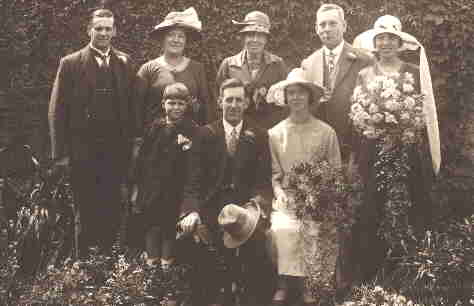
In 1920, Reginald's father Alfred remarried to Fanny Holmes Simpson, who he met while working at Carsons Chocolate factory at Siston. Reginald and his future wife Dorothy are standing left in the picture above which also shows Alfred's parents, George Moss 1847-1928 and Fanny Sophia Cater 1850-1933 (seated couple on the left).


Reginald married Dorothy Agnes Burrell in August 1925 after a long courtship (she attended his father's wedding in 1920) and they initially rented a room in Glen Park, Eastville, opposite Dorothy's family home. In late 1939 or early 1940 they moved to a new council home in Abingdon Road, Fishponds with their young daughter Kathleen.


About 1934, day trip to Weston Super Mare.

Sadly Reginald's health deteriorated and he died in August 1940 aged just 43, leaving a widow and a 7 year old child. His death certificate states pancreatic cancer.


Sunday, February 10, 2019

My Cater ancestors were Churchwardens at Stapleton in the mid to late 1700's, among their duties was the management of the Poor House (at that time situated where College Court now is). Here's a document from that time

Rules and Orders to be observed by the Poor at the Poor House in Stapleton Parish 1 That they shall at all times behave Peaceably, and Quietly, shall not swear Quarrell or use Rude or Indecent Language 2 Shall not Strike or Abuse the Master or Mistress on pain of Punishment, but if Aggriev'd complain to the Overseers 3 Any Person during his or her Maintenance in the House Purloining Selling or Pawning any Materials Implements of Work or Apparell belonging to the House shall be Punished as the Law in that Case Directs 4 Shall take their Clean Linnen from the Mistress every Saturday Morning and bring their Foul Linnen to her every Sunday Morning 5 Shall not go out without Leave or beyond the time allowed on pain of Punishment 6 Shall if able go to Church or such as are Dissenters to some place of Publick Worship at least Once every Sunday and Return to the House as soon as Service is over 7 All shall be in Bed by Nine O'Clock in the Summer and Eight in the Winter 8 Shall not Smoak but Abroad and by no means in any Chamber 9 Persons Convicted of Lying or Swearing shall sit by themselves in the Dining Room the next meal time and have Papers fixt on their Breasts with Infamous Lyer or Common Swearer written thereon and Lose their Dinner Rules for the Master 1 That he do Admit no person into the House without an Order from One or both the Church Wardens of the Parish 2 That he do in no Case Admit any persons till they be first carefully Examined Washed Clean'd and have cloaths. If it be necessary their old cloaths (if worth it) to be Clean'd and Laid by till the poor person be Discharged and then Delivered to the Owner in Exchange for the Cloaths of the House 3 That he do keep Peace and good Order in the House and permit none to Fight Quarrell or Use Rude and Abusive Language without Punishment, either by loss of a Meal or Confinement 4 That he do keep able poor to such Work as they are fit for and call them to it by Ring of Bell at the Hours following from Lady Day to Michaelmas from Six in the Morning to Seven in the Evening and from Michaelmas to Lady Day from Seven in the Morning to Six in the Evening 5 Shall allow them half an Hour at Breakfast and an Hour and Half for Dinner and Play in the Summer and an Hour for the Latter purposes in the Winter and shall allow the Children to play abroad when the Weather will permit and a sufficient time for Learning to Read 6 That he allow none to go into the Garden but those who are set to work therein Rules for the Mistress 1 That she do make Ready the Provisions in a Clean manner and have Breakfast ready by Eight O'Clock in the Summer and Nine in the Winter Dinner at One and Supper when the Workers leave their work 2 That she see the Rooms kept Clean Swept every Day and washed as often as Conveniently may be and have the Windows set open every Day Rainy and Damp Weather ones Excepted and suffer no victuals to be Eaten out of the Dining Room (Except by the Sick) 3 That she keep the Children's Heads and Hands clean also all the Cloaths and Beds that she Mark all the Linnen with the Letters S P H and keep an Exact Acct in a Book of all Household Goods Cloaths and Linnen belonging to the House 4 That she or the Master do see all Fires and Candles be put out by Nine O'Clock in the Summer and Eight O'Clock in the Winter. That the Bill of Fare as Ordered be Punctually observed. 5th October 1773


Tuesday, July 4, 2017

George Burrell (1817-1907) Baptist Minister


More writings by James BURRELL

Lines to my brother George, after a visit to Bristol & Weston Super Mare


I feel now inclined
To write you a line
At this season when all of you meet
I cannot be there
Your pleasures to share
But each of you now, I would greet

Some good times we had
Only one that was sad
And that was at Weston, you know
When we rushed from that place
And, in our haste
I think you then hurt your poor toe (afterwards turned to an attach of Gout)

We felt very sad, to
Find you so bad,
The day we arranged to go out
But twas all for the best
We know not the rest
But shall know hereafter no doubt

I have thought, who can tell
If you had been well
Where that foot would have led you that day
Perhaps, on the Rock
Or some slippery spot
Thus prevented you were kept away

It is on record, in the word
of the Lord, "I'll not suffer thy foot to be moved"
That word was fulfil'd
Tho the flesh did rebel, but Faith, the same can approve

And again do we hear
The Psalms declare
"Thou shalt hold me by my right hand"
The hand on the right is foremost to fight
Tis only by Grace! That we stand

JB