Wednesday, February 11, 2026

Memories of WW2 from a child's perspective

Written by Kathleen Mary Lowe (nee Moss) in 2007, in preparation for a visit to the RUH school in Bath. Pupils there were studying life during the War. 

Notes in [brackets] have been added later to give context and further information.

My mother [Dorothy Agnes Moss nee Burrell]) and I had been staying with her cousin who lived about 20 miles away from our home [2 Glen Park, Eastville, Bristol]. Suddenly everyone seemed to be talking all at once. I didn't know what was going on but I new it was something serious. The next thing I remember was being dragged along the street towards the railway station. There was a thunderstorm going on. It was noisy. I was frightened. I was just 7 years old. I asked my mother what war would be like. She said there would be a lot of noise lounder than the thunder that was crashing around us that day. How right she was, 

During the next few weeks life seemed to go on much the same. The grown up people seemd to talk endlessly about war but I didn't understand it. 

In November 1939, two months after war had been declared, we moved to a new house (in Abingdon Road, Fishponds). It was then that things started to happen.

A strange thing called an Anderson shelter was put in our garden. It was made of corrugated steel., sunk in the ground to half its height and the top was covered with about 2 feet of earth. This we were told is where you go during air raids. It was dark and damp and not nice. In the end I spent very little time in our shelter during air raids, but we spent many nights in another Anderson shelter a couple of hundred yards down the road. This one was in my Auntie Doris's garden.

We spent hours sticking strips of paper on our windows. This we were told would help to stop the glass shattering if a bomb fell nearby. At school we were shown how to get quickly but calmly to the air raid shelters. If a raid started suddenly and there was no time to get to the shelter we practised how to "Take Cover" under the desks.

In January 1940 we had a happy event in the family. Auntie Doris had a baby boy, C____. She already had one son Brian who was four years older than me. When C____ arrived I really didn't want to go to school any more. I would happily have stayed home and looked after him but it was not allowed. Auntie Doris's husband Uncle Ron was not there very often. He was a fireman on a stam engine, the man who shovelled the coal. As time went on we saw even less of him as the trains carried high explosives (bombs and shells), they would hide the train in railway tunnels during raids. 

In May 1940 the news came about Dunkirk. This was a tragedy when British troops invaded France and it went wrong. The men had to be got out but it was not easy. We had a message from our relatives in Manchester to say two of our cousins George and Reg [Moss] were among these troops. Hundreds of small boats were used to ferry men back to England. They were taken to parks in different cities where camps were set up to let them rest. Some came to Eastville Park near us. Uncle Ron, Brian and I went ot see if we could find George and Reg. We walked around for a long  time talking to the soldiers, they looked terribly tired and dirty. We did not find our cousins but heard a few days later that they were safe. George had ridden a bicycle with no tyres or brakes to get to the coast. Reg and his friends had found horses and ridden them some of the way. Then when he arrived at the coast he found a rowing boat and ferried some men out to the waiting ships. He went back for more but the rowing boat overturned. We were all so happy they had come home. Before the war ended they were both to see action again, George in Africa and the Far East. 

Meanwhile we used to visit my grandmother and aunties at Eastville. Auntie Elsie was not home very often. She had an important job at the docks. I never discovered qite what it was but I know she sometimes went on ships until they left territorial waters. Then she climbed down a rope ladder into a little boat to get back. When she finished work she often went to a Bristol hospital where she put on her Red Cross uniform and did a few hours voluntary nursing. Uncle George her brother lived in Taunton with his wife Edith. He was a commercial traveller (rep) for a tobacco company. Because of his job he had a car, there were very few cars then. When war started the authorities found out he had been trained as an engineer. He found himself conscripted to work in the aircraft factory in Gloucester. Auntie Edith decided if he was going there she would go too. They rented a couple of rooms and stayed there until the war ended. During this time Auntie Edith found a job in the Bon Marche. It had been a department store but had been taken over and was a packing centre. Auntie Edith spent the war packing food parcels for the troops.

During this time all sorts of changes were being made to the countryside. All sign posts were taken down to confuse the enemy so if you didn't know your way it was just bad luck. All unnecessary lights were put out. Street lights were hooded and really not much use. All houses and buildings had to be "Blacked Out". Dark curtains or shutters used so that no light could be seen from the outside. My mother was kept busy as she had a sewing machine and was always being asked to make curtains. Rationing started and almost everything you needed to buy was rationed at one time or other. Fresh fruit and vegetables were not rathioned but were in very short supply. People were urged to Dig for Victory! Dig up their flower gardens etc to grow food. Coal, the major fuel for heating houses then was rationed.

Mr Day, our neighbour, on leave from the Air Force decided to build a hen house in the garden. He had visions of lovely fresh eggs. Only Mr Day was no DIY expert. He somehow nailed himself inside. His wife eventually heard him shouting to be let out. She called the neighbours to see their new "chicken", they were all helpless with laughter but in the end they got him out by taking the roof off.

By July we were getting some air raids but not a lot of damage was done in the city. It was at this time I realised my father was very ill. He had been in hospital a couple of times but when he came home I thought he was alright. August 12th was my 8th birthday. My Mum said Dad was too ill for me to have friends in the house but she arranged a little party in the garden. Four days later my father died. After this we spent a lot of time with Auntie Doris and family. I was quite happy about this as Brian and I got on well and played with each others' toys. It helped Mum to be with her sister-in-law.

My mother was given a widow's pension. This amounted to 15 shillings (75p) a week. At that time our house rent was 12 shillings and 6 pence. Mum had to get work. Grandpa Moss said he would get her a job at the Aircraft Company [at Filton] as he worked there. I don't think my mother was really ready to start a job, but one morning [September 25, 1940] she set off. As she could use a sewing machine they put her in the fabric department. To waterproof the fabric they used a chemical known as dope [a kind of lacquer]. It smelt awful and gave off fumes that made your eyes run. By lunchtime Mum had decided she could not do this job, She was going home. As she was leaving she talked to one of the girls and told her she was going. the girl tried to persuade her to have lunch first. When they got to the door the sirens went, the girl said to come with her, everyone was heading for the shelter. My mum would not go, there was a bus pulling out and she got on it and came home. We heard later in the day that the shelter at the aircraft works had been bombed. It was a large bomb, I don't think there were any survivors. The bombing had really started.

From then on we had sporadic raids. In November we had some of the worst raids of the war. On the night of the 24th the city centre was altered for ever. The shopping centre, many offices and public buildings were flattened or burned out. The next morning all there was left was smoking ruins. St Peter's church, although just a shell, still stood and is still there today, left just as it was as a memorial. We were not allowed to go into the town for some time so only knew what had happened from pictures.

Although we had not television and at times no radio I didn't miss them, as we had other entertainments. Most weeks we went to the cinema, this was our favourite entertainment in those days. Bristol had about 40 cinemas so there was a good choice. The theatres kept going and there were musicals, variety shows and pantomimes. Food was short and not much variety but I can't remember ever being really hungry. My mother was a good manager, we as children did miss sweet things. We experimented with different sandwich fillings using what was available. Condensed milk was one filling which was popular. I can't remember the others. Bananas were not seen until after the war finished and were quite a novelty when we saw the first ones. Ice cream was another thing that disappeared for years.

We continued to have air raids, mostly at night. A lot of people just slept in the air raid shelters every night, others went to bed and hoped for the best. If the air raid warning sounded they would then get up and go to the shelter. Early in 1941 we heard people talking about evacuation. This meant the children were taken out of the cities where the bombing was really bad and sent to live with foster parents in the country. Brian my cousin and I were told we would be going and asked if we would like to go together. Brian by this time was 12 years old and didn't really like girls, he wanted to go with his school friends. I didn't know what it was all about so didn't have any idea what to expect. In May we were taken to the railway station and off we went. We had no idea where we were going or when we would see our parents again. As it happened we only went about 40 miles [to Taunton]. When we got off the train we all went into a large building, we were given a drink and a bun then we had to be seen by a doctor. I never found out why because I felt fine but I was sent to an isolation hospital. I was kept there for 10 days and was not happy. Then a lady came with a car and took me to a house in the country [Creech St Michael]. My foster parents were Mr and Mrs Counsel, they were really nice. They had a little girl called Pat, seh was just a bit younger than me, we shared a big bed and had very few arguments. Also living in the house were 2 boys, John (Pat's brother) and George who was also being fostered. I went to a lovely little village school. I don't think I learned very much but I enjoyed it. So we spent the summer playing in the fields and was all very peaceful. lBut I did miss home. In August it was my 9th birthday. My mum came to see me for the day and when it was time for her to go home I wanted to go with her. I stayed another week and then my mum came and fetched me home. Bristol was much as I left it except there were more bombed houses.

So it was back to school in September, most of the evacuees seemed to have returned home. We were still getting air raids but less often. Shortages of almost everything continued. The worst was of course food. I never remember being very hungry it was the lack of variety which was hard to take. The winters were very cold and coal was rationed.

One day we were coming home from school and we couldn't believe our eyes. There were strange army lorries coming down the road. They came one after the other in all I believe about 70 of them. The Americans had arrived! They set up camp nearby and for a while became part of our lives. Most of them were very friendly and liked children. Very few children had fathers at home so really enjoyed the Americans playing rounders with them and teaching them how to play baseball. One morning the Americans had gone, there was no warning, no goodbyes, just gone. The air raids had more or less stopped, the obvious signs of war were there, the bombed buildings etc. They would remain for years, even when the war ended the priority was to build new houses, the wreckage of the old ones could wait.

In 1944 our troops invaded France. They were not alone of course, with them were the Americans and lots of others like Australians and Canadians. After a while the news started to get better and people seemed to be feeling better. I think this war partly because the end of the war was in sight and also because they were getting more sleep. I often wonder how people managed to work all day and then spend hours fire watching or working in hospitals etc.

In May 1945 the great day arrived. To me it seemed to come suddenly. There had been talk about it but when the day arrived it was almost unbelievable. It was great, there was dancing in the strets. In the evening just as it was getting dark, Brian and I went to the top of Cossham Hill near here. We looked out over the city and there were bonfires everywhere, it was a wonderful sight. We had been forbidden to show a light for 6 years, now it didn't matter. The lights could come on again.

On the 8th of May 1995, exactly 50 years later I went to the same place, Cossham Hill in the evening. There were some bonfires and fireworks but it looked so different. It took a while for me to to realise it was it was the street lights - there were only a few dim and shaded ones in 1945. It was sad Brian was not with me as he was in 1945, he died in 1981.


The challenge of the Welsh branches


The above chart well illustrates the issue of researching in Wales - Davies (twice), Thomas, Edwards, Jones & Jenkins are all incredibly common surnames. Finding the 'right' family is almost impossible without some kind of corroborating evidence - family bible, letters or DNA matches.

To date, I have managed to link DNA matches with the common ancestors:

Thomas THOMAS b 1819
Daniel DAVIES  b ca1791 and his wife Ann OWEN
Unknown JENKINS 
Edward EDWARDS b 1780-1791 and his wife Catherine

but it's very slow going as researching each potential link needs to be done carefully. There are plenty of matches, but many have small or private trees and not many have been researched back to before 1800.

Ancestry's Pro Tools are beginning to assist as occasionally cousins have tested - finding their common ancestor helps to narrow down research.

Sunday, January 25, 2026

Lines and coal mines

My first encounter with the Lines family came when I discovered my 3xgt grandmother Hannah Lines. Born 1825 in Stapleton, Gloucestershire, she married twice, had 9 children, and lived to be 93 years old.

Hannah's parents, John Lines and Mary Hendy, both came from local families, based in and around Bitton, Gloucestershire. The families were closely linked with the coal mining industry - areas such as Coalpit Heath bear witness to the now long-gone industry which shaped the culture and the landscape of the area. 

Bitton's neighbouring area of Kingswood was for centuries owned by the Crown, and as its name suggests was kept as an area for hunting. The Royal Family kept a hunting lodge at the summit of the hill where Cossham Hospital is now. The local inhabitants, however, lived a much less luxurious life; working as farm labourers or down the coal mines. 

The coal in this area was not the best quality nor plentiful, and many mine companies went bankrupt while hoping for a lucky strike. Safety precautions were basic, and accidents not uncommon. John Lines' grandfather Michael Lines (1740-1766) died aged just 26 in a mine accident.

Hannah's younger brother John Lines was born 1828 at the family home in Thicket Road, Stapleton, was interviewed in 1842 by a Government Commission into the Employment and Condition of Children in Mines and Manufactories.

John Lines, aged 13, works for Sir John Smyth and Co. He hauls by the girdle and has done so for four years.  The girdle never hurts him and he earns 1s. a day.  He works eight hours and has potatoes and meat for dinner when he goes home.  He attends the Wesleyan Sunday-school at Kingswood and can read a little.  He walks four miles to the pit every morning.

The coal mining industry in Gloucestershire eventually failed and John, and his brothers Isaac and Michael, went to the USA to work in the mining industry there. Michael soon returned to the UK, but  Isaac settled in Missouri and John in Illinois. Many others went to South Wales, the North East and Yorkshire where mining was still profitable.

Hannah, however, remained in Bristol. Aged 19, she married George Moss, a coal haulier from St George. The couple initially lived in rented rooms in St George, but after the death of her parents in 1853 they moved to the family home in Thicket Road, where she lived for the rest of her life.

Hannah and George had 5 children, all of whom survived infancy, but in 1855 when the youngest daughter was 2 years old, George died of pneumonia. Hannah was left a widow aged 30 with 5 young children. In many cases a widow in this situation would have remarried as soon as possible, but clearly Hannah was not destitute, as when she did remarry, it was in 1862, seven years later. Hannah's second husband, Joseph Millard, was a widower with 3 children, a coal miner and a neighbour. They had a further 4 children making a total of 12.

Joseph Millard died in 1890 leaving Hannah again a widow and still in her family home. She remained living there alone with the support of family living nearby for 30 years, until an accidental fall near an open fire led to her death.

Hannah's lifetime spanned the most incredible era for social change: the coming of the railways and commercial steam ships, the invention of telegraph and wireless radio, the automobile, and electricity for lighting were visible changes, but the invention of pasteurization, anaethesia, X rays and the understanding of antisepsis changed daily life enormously. She was born at a time when industry and mechanisation were beginning to make an impact on the lives of ordinary rural people. She lived through the reigns of George VI, William IV, Victoria, Edward VII and George V. She probably never travelled further than the city of Bristol, but the world came to her as her siblings and friends travelled and and sent back news of incredible places and experiences.


Saturday, July 5, 2025

Life and times of Reginald Moss 1897-1940


Reginald Moss was born in Bristol on 24th May, 1897, the younger son of Alfred Moss, a hot water engineer, and Tinney nee Emmett. Tinney's name is mis-transcribed in some records as 'Fanny' or 'Jenny'.

Alfred & Tinney's marriage apparently wasn't a happy one and by the 1911 census they had separated. The couple came from very different backgrounds (Afred's parents owned their house in Queen Street, Eastville and Alfred was an engineer whereas Tinney's father was an unskilled worker from Clay Bottom, St George).  

In the 1911 census Tinney (by then living with just her eldest daughter Elsie) is described as 'an invalid for 13 years'.  Reginald and his siblings Frederick and Doris are living with Alfred at his parents house.

There is a family story that the children were neglected and that Tinney was an unfit mother; the implication was that she drank. Her death certificate, in 1918, lists her cause of death as rheumatoid arthritis and endocarditis. It is, in fairness, not possible to know whether she drank as a form of pain relief, or if there were other factors, eg perhaps her illness was seen as an excuse not to actively care for her children.


Growing up in Eastville, Reginald would no doubt have enjoyed the nearby Eastville Park. He may not have been the fittest of boys, but played as goalie for a local team - here he is in 1911.

Reginald and his siblings Elsie and Doris did not enjoy particularly good health. Elsie developed TB and heart problems and died aged just 33, leaving three small sons. Doris had rheumatoid arthritis and diabetes. And when Reginald applied to enlist in the Army in 1915, he was refused on medical grounds. It is possible he may have lived with Type 2 diabetes. 


By late 1917, however, with the Third Ypres Campaign taking place in appalling conditions, the need for recruits was urgent and Reginald was accepted into the 8th Battalion of the Gloucesters Regiment. In January 1918 he was sent to France and then to the front at Messines. Just 4 months later, he took part in the Battle of the Lys, also known as the 4th Battle of Ypres. Descriptions of the battle, which began at daybreak on 10th April, show an appalling situation with tired men, trapped in mud-filled trenches and surrounded by exploding shells, rifle fire and occasional gas assaults. 


Reginald was captured during the battle and sent hundreds of miles to a POW camp at Dülmen, Germany. Dülmen held up to 5000 men, living in huts of 120 to 140 each. The men worked from 7am until midday, and 2pm until sundown, on tasks which were considered "occupation" rather than "hard labour". There was a prison hospital and punishment cells. The huts were reported to be airy and clean, with disinfection apparatus (as men arriving from the trenches often brought lice with them) and the men were obliged to bathe weekly but permitted to do so more frequently.

Regardless of the relatively humane conditions of the camp, Reginald's experience of life in the trenches, the appalling loss of life, and the internment must have been incredibly traumatic. 


Reginald was discharged from the Army in December 1918 and received a disability pension, possibly due to lung damage, as he is not thought to have been injured. He returned to live with his grandparents at Queen Street, remaining there even after his father remarried in 1920.

After the war Reginald worked for Bristol Tramway as an engineer and later as a bus conductor. His health remained a concern, and with no National Health service at that time, he wouldn't have had easy access to medical support.


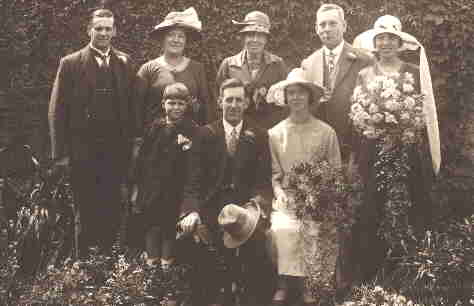
In 1920, Reginald's father Alfred remarried to Fanny Holmes Simpson, who he met while working at Carsons Chocolate factory at Siston. Reginald and his future wife Dorothy are standing left in the picture above which also shows Alfred's parents, George Moss 1847-1928 and Fanny Sophia Cater 1850-1933 (seated couple on the left).


Reginald married Dorothy Agnes Burrell in August 1925 after a long courtship (she attended his father's wedding in 1920) and they initially rented a room in Glen Park, Eastville, opposite Dorothy's family home. In late 1939 or early 1940 they moved to a new council home in Abingdon Road, Fishponds with their young daughter Kathleen.


About 1934, day trip to Weston Super Mare.

Sadly Reginald's health deteriorated and he died in August 1940 aged just 43, leaving a widow and a 7 year old child. His death certificate states pancreatic cancer.


Sunday, February 10, 2019

My Cater ancestors were Churchwardens at Stapleton in the mid to late 1700's, among their duties was the management of the Poor House (at that time situated where College Court now is). Here's a document from that time

Rules and Orders to be observed by the Poor at the Poor House in Stapleton Parish 1 That they shall at all times behave Peaceably, and Quietly, shall not swear Quarrell or use Rude or Indecent Language 2 Shall not Strike or Abuse the Master or Mistress on pain of Punishment, but if Aggriev'd complain to the Overseers 3 Any Person during his or her Maintenance in the House Purloining Selling or Pawning any Materials Implements of Work or Apparell belonging to the House shall be Punished as the Law in that Case Directs 4 Shall take their Clean Linnen from the Mistress every Saturday Morning and bring their Foul Linnen to her every Sunday Morning 5 Shall not go out without Leave or beyond the time allowed on pain of Punishment 6 Shall if able go to Church or such as are Dissenters to some place of Publick Worship at least Once every Sunday and Return to the House as soon as Service is over 7 All shall be in Bed by Nine O'Clock in the Summer and Eight in the Winter 8 Shall not Smoak but Abroad and by no means in any Chamber 9 Persons Convicted of Lying or Swearing shall sit by themselves in the Dining Room the next meal time and have Papers fixt on their Breasts with Infamous Lyer or Common Swearer written thereon and Lose their Dinner Rules for the Master 1 That he do Admit no person into the House without an Order from One or both the Church Wardens of the Parish 2 That he do in no Case Admit any persons till they be first carefully Examined Washed Clean'd and have cloaths. If it be necessary their old cloaths (if worth it) to be Clean'd and Laid by till the poor person be Discharged and then Delivered to the Owner in Exchange for the Cloaths of the House 3 That he do keep Peace and good Order in the House and permit none to Fight Quarrell or Use Rude and Abusive Language without Punishment, either by loss of a Meal or Confinement 4 That he do keep able poor to such Work as they are fit for and call them to it by Ring of Bell at the Hours following from Lady Day to Michaelmas from Six in the Morning to Seven in the Evening and from Michaelmas to Lady Day from Seven in the Morning to Six in the Evening 5 Shall allow them half an Hour at Breakfast and an Hour and Half for Dinner and Play in the Summer and an Hour for the Latter purposes in the Winter and shall allow the Children to play abroad when the Weather will permit and a sufficient time for Learning to Read 6 That he allow none to go into the Garden but those who are set to work therein Rules for the Mistress 1 That she do make Ready the Provisions in a Clean manner and have Breakfast ready by Eight O'Clock in the Summer and Nine in the Winter Dinner at One and Supper when the Workers leave their work 2 That she see the Rooms kept Clean Swept every Day and washed as often as Conveniently may be and have the Windows set open every Day Rainy and Damp Weather ones Excepted and suffer no victuals to be Eaten out of the Dining Room (Except by the Sick) 3 That she keep the Children's Heads and Hands clean also all the Cloaths and Beds that she Mark all the Linnen with the Letters S P H and keep an Exact Acct in a Book of all Household Goods Cloaths and Linnen belonging to the House 4 That she or the Master do see all Fires and Candles be put out by Nine O'Clock in the Summer and Eight O'Clock in the Winter. That the Bill of Fare as Ordered be Punctually observed. 5th October 1773


Tuesday, July 4, 2017

George Burrell (1817-1907) Baptist Minister


More writings by James BURRELL

Lines to my brother George, after a visit to Bristol & Weston Super Mare


I feel now inclined
To write you a line
At this season when all of you meet
I cannot be there
Your pleasures to share
But each of you now, I would greet

Some good times we had
Only one that was sad
And that was at Weston, you know
When we rushed from that place
And, in our haste
I think you then hurt your poor toe (afterwards turned to an attach of Gout)

We felt very sad, to
Find you so bad,
The day we arranged to go out
But twas all for the best
We know not the rest
But shall know hereafter no doubt

I have thought, who can tell
If you had been well
Where that foot would have led you that day
Perhaps, on the Rock
Or some slippery spot
Thus prevented you were kept away

It is on record, in the word
of the Lord, "I'll not suffer thy foot to be moved"
That word was fulfil'd
Tho the flesh did rebel, but Faith, the same can approve

And again do we hear
The Psalms declare
"Thou shalt hold me by my right hand"
The hand on the right is foremost to fight
Tis only by Grace! That we stand

JB


From the writings of James BURRELL

Lines composed by Edward Bentley BURRELL, on the sudden death of his dear Mother, on the 2nd April 1879


Alas! Our dearest earthly friend is gone, without the slightest warning from us torn
Oh Mother! Could we once more hear thy voice, our deeply saddened hearts would then rejoice

But we shall never more behold her here, no more receive her loving words of cheer;
Those eyes, so often wet with tears for us, will never shed a tear of sorrow thus

A gap is made! and always will remain, for none on earth can fill that gap again
The cares of life that once disturbed her breast are gone for ever, for she's now at rest

She's crossed the sea of time, and reached that shore where sorrow, sin and death shall be no more:
And now in heaven she lives, a glorious saint, and sings the song of Grace without restraint

Full forty years she knew and loved the Lord, and helped to spread His wondrous Grace abroad
She bore the Cross, but now has laid it down, and in those glorious Mansions, wears a crown

Her day of care on earth is now complete, the night came on, she sweetly fell asleep
Her mortal body we shall no more see, for in the grave it rests from pain set free

In peaceful solitude her dust shall sleep, till Christ himself shall call her from the deep
Then, at his bidding she shall quickly rise, and join her happy spirit in the skies

In Heaven to spend a long eternal day, where radiant joy, and bliss can ne'er decay
One glorious Object there attracts her mind; in Him perpetual bliss she'll always find

We will not weep, for soon the time will come when we shall join her in that happy home;
Life's little day on earth will soon be passed, and we shall reach the Glory world at last

Note to James' granddaughter Beatrice - PS the above lines were written by your cousin 'Ted' who soon followed his dear Mother home  JB

Monday, October 27, 2014

From The Bristol Mercury, Thursday, December 7, 1893 - Accident at the Drill Hall

At the Drill Hall
Collapse of a Gallery
Fall of 400 People
List of the Injured
Plenty of novelty and excitement had been promised concerning last night’s entertainment at the Drill Hall, but nothing approaching the sensation which transpired was, of course, either promised or expected.

Those who knew anything of Prof. Smith’s interesting performances were fully prepared to see the hall well filled, in view of the special circumstances of the occasion, but the most sanguine never dreamt that there would be such a demand for seats, and the management of the show could hardly have surmised that the performance would be so popular. In expectation of a full house, persons who had secured tickets went unusually early; but after half-past seven there was hardly any getting into the building, and it was only by persistent pushing or by the friendly help of the police that ticket holders could effect an entrance.

 At a quarter to eight the scene inside the premises was a notable one. Temporary galleries running all round the building had been constructed, and with the exception of the highest priced seats – which were marked 4s, but called as 6s – every place was crowded. The crush was greatest in the shilling gallery, and it was here that the mishap occurred subsequently. Long before eight o’clock the doors had been closed, but still the people seemed everywhere struggling for seats, and many who were unable to find places on the cheaper sides of the house rushed over to the reserved gallery, which a few seconds later they were requested to vacate. Most of them obeyed the request, and the crush in the shilling gallery as the disturbed ones forced their way up through the dense mass of people became tremendous.

The gallery, it should be explained, was built in four sections, the two inner ones of which gave way. It was composed of new, stout timber, but in the opinion of many who afterward examined the material it lacked sufficient support for a structure which was to bear the weight of so much human life.

The officials of the show were busy getting people to their places at a few minutes after eight o’clock, when, without the slightest warning, the shilling gallery – at the end nearest to the Salisbury Club – collapsed. Simultaneously with a cry of alarm throughout the building all eyes turned in the direction of the gallery, the occupants of the middle two sections of which were seen to throw up their arms and disappear from view almost gently as the timbers broke or were torn from their fastenings one after another.

Some idea of the nature of the gallery may be gathered from the fact that there were some 18 or 20 planks for seats running up from the enclosure to the wall, and it was estimated that from 400 to 500 persons crowded the two inner sections. Seeing that those on the back seats must have fallen a distance of 20 feet or more, it was feared that the calamity was one which would be attended with fatal results, but fortunately the consequences proved to be not of so serious a nature.

Persons in the front or lower seats of the structure were very soon on their legs again and away into the enclosure, but it was some time before those behind could be got out from the confuses mass of human beings and broken timber forming one huge heap. To their credit, the remainder of the immense audience behaved admirably, and by sitting still enabled the show officials and the police to proceed uninterruptedly with the work of rescue.

Those of the galleryites who had escaped unhurt made their way to places in the reserved gallery, from which they were no longer excluded, and to the great relief of everybody present it was soon found not only that there was nothing worse than injury but that those hurt numbered less than a dozen. So far as could be seen only one woman and one boy were amongst those who fell and apparently they escaped, like the majority, with a severe shock to the system.

No time was lost in attending to the wants of the injured who were removed to the Royal Infirmary. Valuable help was rendered by a large number of police under Chief Supt. Cann and Supt. Croker, and a little later the scene of the accident was visited by the Chief Constable. After an examination, it was considered that the two sections of the gallery still standing were in a safe condition, and they were very largely occupied throughout the evening, despite the ominous looking gap between them.

All this had brought the hands of the clock to half-past eight, and then Prof. Norton B Smith found time to address a few words to the two thousand or so who, by their exemplary conduct, had prevented the development of a very alarming incident into a panic. It was a fortunate circumstance, in one sense, that very few women – probably less than a dozen – were present, although in justice to the sex it should be stated that the few who were there behaved no less admirably than did the men.

In addressing his audience, Professor Smith stated that it was his first accident in the course of many years’ experience; and, expressing deep regret at what had occurred, he took the opportunity of clearing the management so far as he could from responsibility for the mishap. He stated that the galleries had been erected by a contractor in the city – he ignored cries of “Name” – and that in good faith the management left the work in his hands. To this the manager (Mr Nat Behrens) added a few words, and, after blaming the people for the unseemly rush for places, he announced that the feeling of the management would prompt them – he promised on behalf of Professor Smith and himself – to give the proceeds of that evening to the sufferers by the accident, a statement which, of course, was hailed with a loud outburst of applause.

It was 8.40 when Professor Smith began the performance, and his first subject was a horse belonging to Mr George White, of Cotham. The animal was a very nervous one, but the professor, probably upset to some extent by the occurrence of a few minutes before, seemed to have more than usual trouble in reducing the animal to control and quietude in the extraordinary conditions to which he subjects all horses sent into the ring.

The audience showed some signs of impatience when the second subject proved not to be Mr Shellard’s stallion; but they were advised to wait a few minutes, and at 9.40 the promised event of the evening arrived. The stallion, a black, ungainly looking brute, was brought into the ring wearing mask and muzzle, and, with all eyes upon him, was led to the middle of the enclosure.

The professor explained that never before had he seen the animal, and gave as the horse’s record that he had killed one man and bitten the arm off another. The horse’s mask having been taken off, he was surrounded by Mr Smith’s assistants and, by means of a number of ropes wound around him, was thrown to the ground, kicking and struggling tremendously. He was then safely secured in the manner adopted by Professor Smith – by reins and ropes attached to the front fetlock joints – and thus bound he proved as quiet a subject as either of the horses previously dealt with, remaining quiet during the beating of drums and firing of revolvers: allowing the professor to place his hand in its mouth over and over again, and going quietly in harness during the blowing of the steam whistle and the infliction of other tests.

Every act of the professor and his assistants were followed with the closest attention, and the accomplishment of test after test was hailed with an outburst of applause, clearly indicating the fullest satisfaction of the spectators. Owing to the late hour the programme had to be shortened, and at the close it was announced that Mr Shellard’s stallion would be amongst the subjects to be dealt with at greater length to-night. The tremendous crowd of people awaiting the close of the performance interfered somewhat with the outlet, and consequently more than the usual period of time was occupied in discharging the building of its immense audience; but as far as was observable everything passed off in the most orderly manner.

Outside The Gates
Many of the people who crowded Queen’s Road immediately prior to the accident had been disappointed at learning that all the shilling seats in the Drill Hall had been taken; but notwithstanding repeated explanations to this end pressure around the entrance to the building continued. “No more shilling tickets” was the managerial order; and soon, some time before eight o’clock, Mr Nat Behrens had to announce from the gates that the two shilling section of the house had also been filled.

The gates had to be closed, some impatience being exhibited by people in the crowd; and the hasty intimation conveyed to Mr Nat Behrens that something was amiss inside was only imperfectly understood by those who blocked the roadway.

But in a few minutes matters were made more clear; and interest and anxiety were at once aroused on two injured persons being carried to a cab. They were a man named Brewer, and a boy named Young. Detective Inspector Robertson, who had witnessed the accident, and had assisted in extricating the injured from the shattered timbers amongst which they had fallen, had found Brewer lying head downwards, jammed between portions of woodwork, Young being on top of him.

The wonder was that they results of the accident, so far as these particular cases were concerned, were not more grave; as it was Brewer was unconscious when removed, Young having previously been carried to a place of safety on the shoulders of a man, who promptly volunteered assistance. Detective Inspector Robertson recognising the importance of the sufferers receiving medical attention without delay, lost no time in getting them outside the hall, where a private cab happened  to be stationed. Without waiting to make inquiry, he had his charges carefully placed in the vehicle, and the driver at once conveyed them to the Infirmary, where they were soon in the casualty ward.

Meanwhile, rumours spread alarmingly. The hurried departure of the cab sent to the Infirmary was sufficient to set questions and conjecture afoot; and in a short time the place was besieged with eager inquirers. The police, strengthened by the arrival of several constables, did their best to regulate traffic and maintain a clear space for the ingress and egress of those whom duty summoned to the Drill hall. Every incident caused commotion amongst the hundreds of people who speedily blocked the thoroughfare.

Following Detective Inspector Robertson’s departure, there was the hasty journey of Inspector Gotts to the central police station for the ambulance wagon and the hand stretcher. The stretcher from the Clifton station was also sent for, and there was work for both stretchers and the wagon when they were brought on the scene. Reliance was not placed on these alone. Cabs were requisitioned, so that time should not be wasted in despatching people who were hurt to the Infirmary, and so promptly were these labours discharged that it was calculated by a quarter to nine all the sufferers had been removed. But by this hour public excitement had become if anything more intensified.

Rumours of a most alarming character had gone abroad, and from all parts of the city and Clifton, people had come to glean the latest particular. With the gates closed and admission to casual inquirers refused, it was freely surmised that the performance within the building had been stopped, and in many instances imagination went far wide of the mark in picturing the nature of the accident. The police did their best to satisfy those who were solicitous for the safety of friends believed to be inside the hall, but it was not until the evening had considerably advanced that false alarms were effectively negitived, and the crowd, which at one time numbered, it was estimated, upwards of 3000 people, diminished. And not until the building was emptied of its audience between ten and eleven o’clock did the people entirely disperse.

At The Infirmary
List of the Wounded
The news of the accident quickly spread, and immediately the police at the Central Station received information of what had occurred the police ambulance was sent up to the Drill hall to facilitate the removal of the injured to the Infirmary.

Those who were earliest extricated from the mass of fractured timber and needed surgical treatment were driven down in cabs to the institution, and the rest were brought there in the ambulance. The first of the sufferers was admitted about a quarter past eight, and others kept arriving for fully half an hour more, and all the injured were taken into the casualty room, where they were attended to by Mr W J Hill (the house surgeon), Mr H L Ormerod (the house physician), Mr E H Clarke (one of the resident staff) and Mr Beavis (student for the week).

A large crowd assembled outside the Infirmary, people from all parts of the city flocking there to learn if their friends were among those hurt, and the officials in the porters’ lodge were kept well occupied for a long time in replying to the many anxious inquiries continually made.

Five of the men admitted – apparently no women were injured – received treatment and were then able to leave for their own homes, but in a similar number of cases the medical staff ordered their detention in the institution. One of these latter came from Newport and of the others, two came from neighbouring villages. It would seem that the audience at the Drill hall contained a large sprinkling of people who had come from places around Bristol, attracted to the hall by the novelty of the entertainment.

The injured persons taken to the  Infirmary were:-
Joseph Williams (17), Westbury-on-Trym; fractured ribs and thigh
Thomas Pope (47), 23 Deacon Street, Dean lane; fractured ankle
William Templer (32), 145 Whitehouse lane, Bedminster; broken leg
John Blake (37), 31 Baldwin Street, Newport; fractured ribs and arm
Samuel Wall (60), Dundry; injury to eye and ankle

Not Detained
Edward Young  (14), 30 Bedford street, Stapleton Rd, injured leg
Henry Brewer (37) 7 Bush lane, Easton; cut head
Cornelius Burrell (36) Wardlow road, Bedminster; injured arm
George Bakehouse (62) 116 Hotwell road; injured ankle
William Parchler (16) 116 Oxford street, Totterdown;  injured ankle

—

Narrative of the Accident

Williams, the most seriously hurt of the injured, was accompanied to the hall by a party of friends from Westbury, and among them was Chas. Partridge, a gardener living in the village, who, in an interview with a Mercury reporter, said that he and his companion occupied shilling seats, about the sixth row from the top at the far end of the hall, facing the clock.

The place was crowded; and the Professor, on entering the arena, requested several people standing in the enclosure to find seats, as he would not allow anyone to stand during the performance. They were accommodated with seats, and the Professor began a few preliminary remarks before giving his exposition of horse taming. Suddenly, whilst he was speaking, there was a crash; and, continued Williams, “the seats where were sitting gave way, and all the people in that part fell with the falling timber in a confused mass. Two or three women who had been sitting near fell with us, and one was almost alongside me.

The smashing of the woodwork and the cries of the injured caused intense excitement and the people from the other parts of the hall crowded round where the accident had occurred. I happened, very fortunately, to drop between one of the planks, but there were several people on top of me, and though I heard Williams calling to me for assistance – he was crushed between the timber – I could not get to him until I had been extricated. I must have been lying there for about ten minutes; but directly I was free, with the help of others, I got Williams out from the debris. We could see he was badly hurt and suffering great pain.

Two or three gentlemen – doctors or students, I suppose – finding that his thigh was broken, strapped him up as well they could; and as by this time the police had arrived, and had cleared the crowd away from that part of the building, we were able to convey the poor fellow on a stretcher to the police ambulance, I went with him to the Infirmary, and saw him taken into the casualty room to be attended to. As for myself, I did not trouble the doctors, although my back was very sore, through the weight of the people who fell on top of me.”

On inquiry at midnight at the Infirmary we learnt that the five persons detained there were making as favourable progress as could be expected, including Williams, who, we were informed, would probably recover from his serious injuries.


  • Cornelius Burrell (1857-1928) —was a haulier who lived in the Bedminster area most of his life. 

Wednesday, February 20, 2013

Tokens of love?

Most families have a few trinkets that have survived the years, often without the accompanying background story. Here are a couple of ours.


Chinese coin:

This is a Hu Poo 20 cash coin dating from around 1903-1905. Not particularly rare and not valuable, I understand, but how did it end up in suburban Bristol?


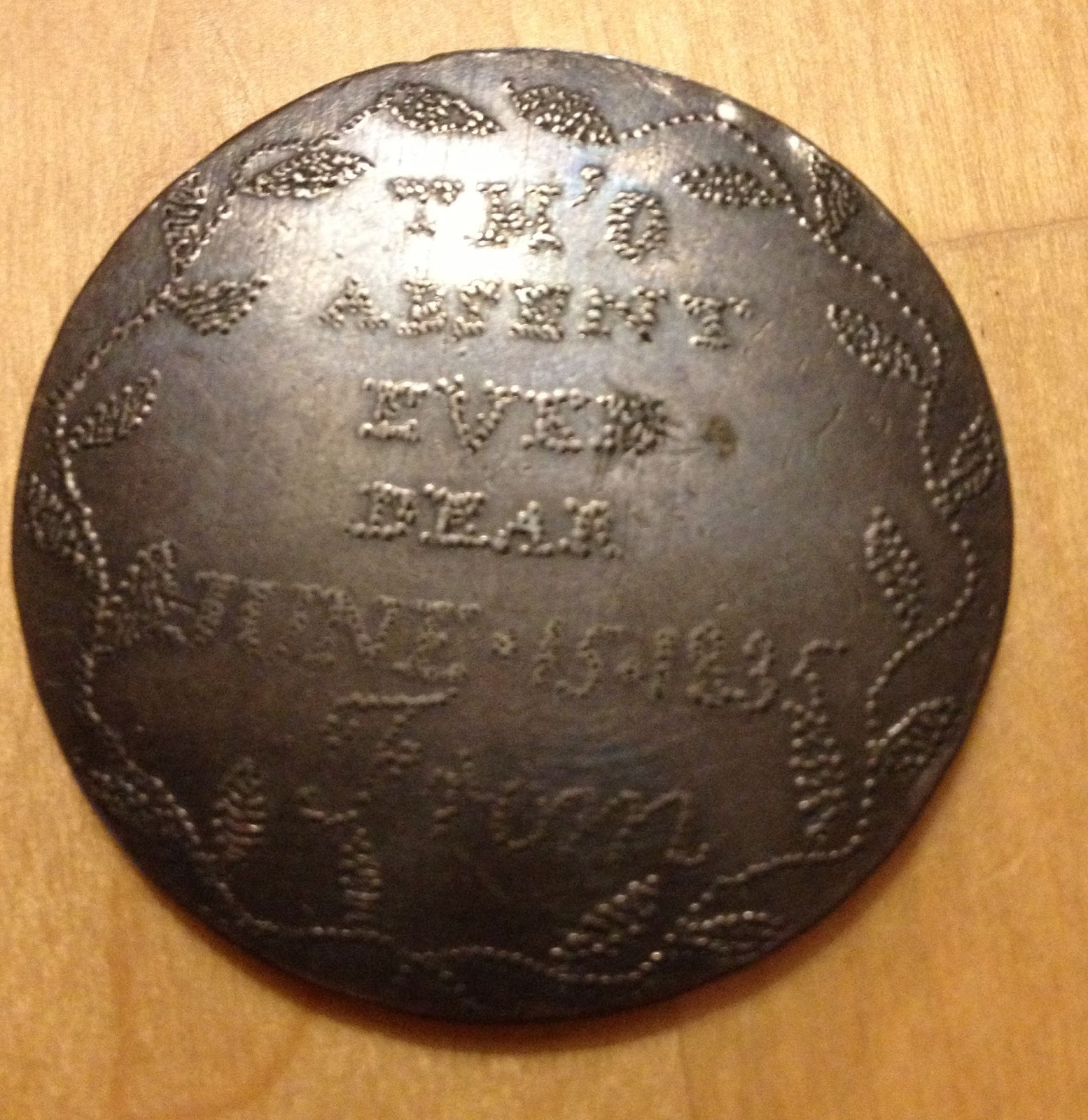
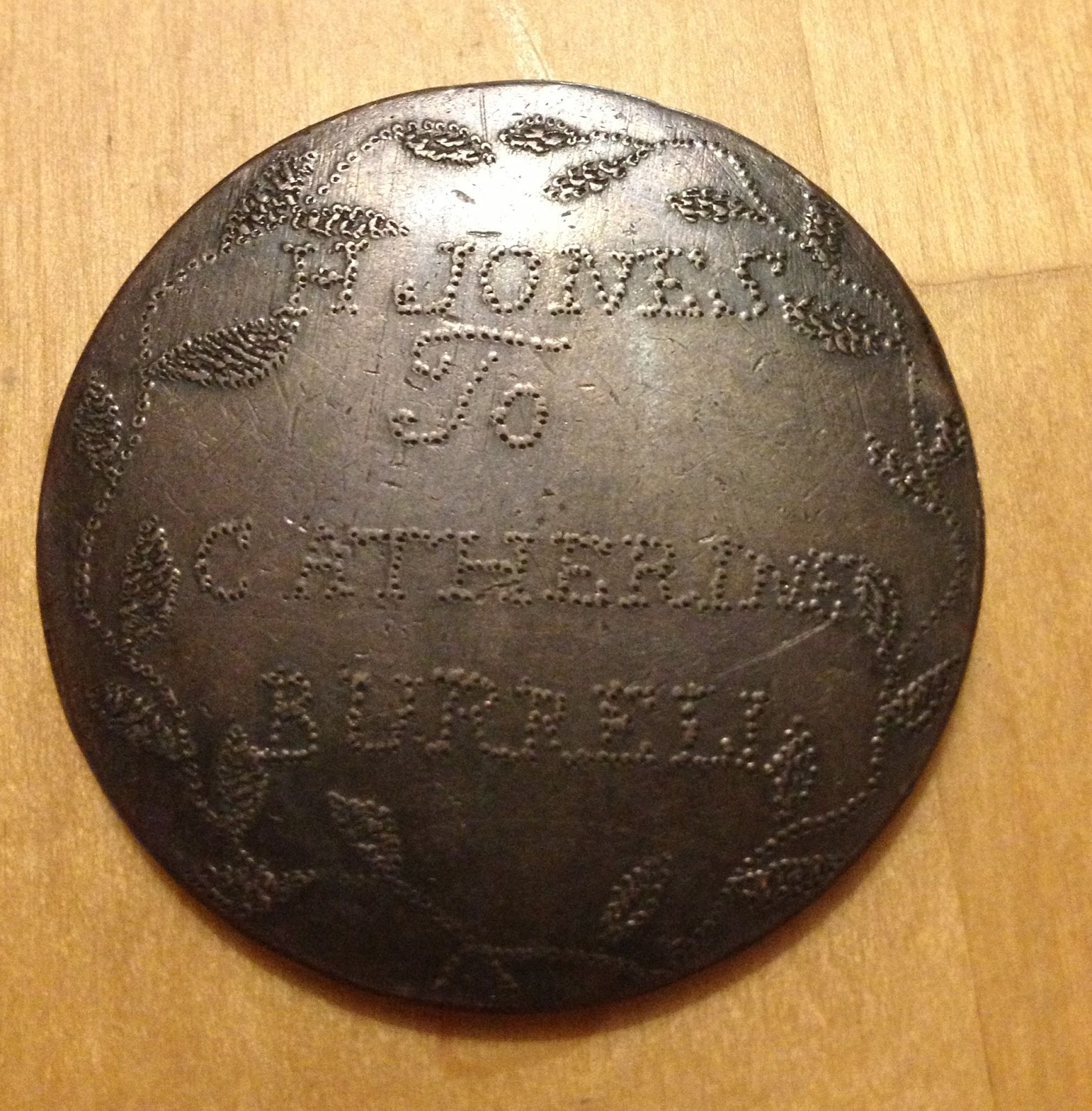
Engraved token:

This token, inscribed "Th'o absent ever dear - June 15 1835 - from H Jones to Catherine Burrell" might, at first glance, be easier to explain. But to date we haven't found a link to a Catherine Burrell nor an H Jones. Presuming that Catherine was an adult in 1835, she may have been sister, aunt or other relation to my 2xgt grandfather James BURRELL (born in 1826), but since the token was passed into our branch of the family, I think it unlikely that she had children of her own.

The two coins might, of course, not be linked at all, but they both seem to originate from our Burrell ancestors. I'm aware that 1835 was an era when missionaries were being expelled from China. My 2xgt grandfather, James BURRELL, had an elder brother George who was a Baptist Minister, and the family were strongly linked with the church, so perhaps there's a missionary connection there. Any ideas welcome!!


Saturday, January 19, 2013

An Unhappy Woman, and a Maritime Connection

My paternal grandmother's ancestors were always something of a mystery to me, as she talked very little about her family, and died when I was young. Talking to other family members didn't help much, as we weren't in touch with her close family, and the furthest I could go using verbal history was her mother, Lilian Lenda CARTER, born about 1889 and probably in Essex. 


Lilian as a young adult

I have never been able to find a birth registration or baptism for Lilian Lenda CARTER. She is variously enumerated on the censuses as having been born in "Hounslow, MDX" and "Onslow, ESSEX". I suspect her given name at that time was simply Lilly as that is how she appears in the 1891 census, where she appears with both parents, Charles Andrews CARTER and Sarah Elinda nee THOMPSON. Lilian's mother, Sarah Elinda THOMPSON, was born in Harwich in 1866, the daughter of Thomas Turner THOMPSON and Elizabeth GARNETT. I am intrigued by the unusual second name, Elinda, and don't know its origins.

Sarah, sadly died in childbirth at the age of 25; her infant son Charles Thomas CARTER survived, and can be found in 1901 living with his paternal grandmother Harriet CARTER in Kent. I can find no trace of him after that. Sarah's young daughter, then simply enumerated as Lily CARTER, is with her maternal grandfather Thomas Turner THOMPSON and the housekeeper Eliza in 1901, whilst her father has remarried and is living with his new family in Dovercourt. I think there was some contact between father and daughter, but Lilian's father had himself had a very difficult childhood and had lost a parent very young.

By 1909, at age 17, Lily had reinvented herself as "Lilian Lenda", (perhaps this was a reference to her mother's middle name Elinda) and was married to 31yr old Albert Edwin THORN, a brewer's clerk from Thetford. It wasn't a happy marriage, although 8 children were born. One of the rare stories my grandmother Irene told about her youth was of being bullied by her 3 older brothers and I understood she was expected to care for her 4 younger sisters - other relatives told me that Lilian 'was often ill and frequently bed-bound'. I suspect that Lilian suffered from severe depression.


Lilian and her first husband Albert Edwin Thorn

Lilian's husband Albert, much older than her, died suddenly of a heart attack at the age of 64. Lilian's children were adult by this time, so she sought work, and as this was during WW2, we know that she spent some time as a nurse.

Lilian as an adult

Lilian later became a housekeeper for a recently widowed James Dale BEAVEN, a businessman. The couple married in 1942, but the relationship remained very much one of householder & servant, and Lilian left him after a few unhappy years. Her last home was with her eldest son, sleeping on his sofa, and the verdict at her inquest was that she committed suicide. She was 59.

Moving back a generation, Lilian's grandfather Thomas Turner THOMPSON was a mariner in his younger years, following in his father George's footsteps -  in fact he was born in Coastguard Cottages at Cromer - but later he worked for the railways as a quay foreman in Harwich. Thomas's wife, Elizabeth GARNETT, came from a large Harwich fishing family and was one of 11 children. They had strong links with the Navy and descendants can be found in several parts of the globe.

Thomas and Elizabeth had 6 children;
Thomas Daniel born 1860, married Alice EVERETT, died 1908
Elizabeth Sarah Ann b 1862, married Edward TURTON, died 1934
Sarah Elinda b1866, married Charles Andrews CARTER, died 1891
Ellen Brown b1870, nothing further known after 1881
Clara Rebecca b1873, nothing further known after 1891
Hilda b1875, died 1897

Elizabeth died in 1889 and Thomas didn't remarry, but is thereafter enumerated with a housekeeper, Eliza JUBY nee NIXON, until his death in 1916.


Friday, October 12, 2012

Crawling backwards, faster

From time to time I check in on the National Archives site to see what's new there. It's an incredible resource although some patience and determined searching is needed to get results, especially if you are researching a common name, or a surname that is also a commonly used word - try BINDING or CATER, for example, and you pull up all kinds of documents which contain those words.

This week, however, I discovered some new leads on my CATER ancestors in Bedfordshire - documents from Leicester & Rutland Record Office have been included since my last visit. They mention my ancestor Andrew CATER, clerk of Elstow, and his wife Alice nee CLARKE, and property in the village of Wrestlingworth. Entering "Wrestlingworth" as a search term gave me lots of CLARKE entries, and cross-referencing these with PRO Wills and parish register transcripts has helped me draw up an extensive CLARKE tree, going back a further 2 generations on Alice's maternal and paternal lines. Alice was my 8xgt grandmother, so these are some of the earliest ancestors in my tree. The Wills and some other documents are downloadable, so I don't even need to rely on other people's transcriptions but can struggle through and make my own!

When I began researching in the 1970's, the only way to gain any information was to travel to the locality and search original documents in dusty record offices. My annual holidays were planned around such road trips, often camping nearby, and washing off the grime of the books before tucking into a picnic. Now so much information is online, even scans of original documents, and networking with other researchers allows those of us who can't travel much the chance to check transcripts against the originals. What might have taken months or years to discover can now be done in minutes, from an armchair at home.

But it's important not to lose sight of the need to check transcripts against original sources, and to look for corroborating evidence. Just because your ancestor had an uncommon name, for example, not everyone with that same name is related! Newer ways of working have cut corners for us, but the method remains the same.

Saturday, September 22, 2012

Mystery and Conflict

One longstanding (25 yrs plus!) brick wall in my research is the relationship between the WYATT and CATER families in Bristol.

In 1714, Thomas WEBB (?-1718) wrote a will in which he described Andrew CATER the younger as his "wife's kinsman", and left him a significant piece of land in Stapleton, Gloucestershire. Mary WEBB (1649-1729), Thomas's wife, was born Mary WYATT, and came from a merchant family with strong London connections. Andrew's ancestors are believed to have had property in both Bedfordshire and London.

The use of the word 'kinsman' implies a more distant relationship than close family - but how distant? And can any further information be found on Andrew CATER - clearly he was the son of another Andrew, and I believe he may have been born about 1661 in Elstow, Bedfordshire. His wife may have been a Mary, but nothing further is known of her.

So far I have found no further clues, except that Andrew CATER named his first son Wyatt CATER, and his grandson was John Wyatt CATER. In fact I have found 17 direct descendants of Andrew who were named either John Wyatt CATER or Wyatt CATER. As for the bequest of land, that only lasted a little more than a generation, as by 1779 it was all mortgaged or sold.


Recently I came across a Probate court case between Andrew CATER and the heirs of Thomas WEBB - and I'm still discovering more about it. The National Archives have provided copies of 4 documents from the case - including the complaint of Andrew CATER, and replies from the widowed Mary WEBB, and from Francis JAY, a nephew of Thomas, who was guardian of Thomas's son (who was declared insane).

Even if this bundle of documents doesn't give the answer, it's another step towards a fuller picture of these families. Another brick in a very holey wall!


Thursday, May 3, 2012


Researching the Binding surname

I have been fortunate to make links over the years with other people researching their Binding ancestry in Somerset.  The name is uncommon, and can also be written as Bindon, Binedin etc.  Surname spellings have only become standardised in the last 100 years or so, and until around 1870 the levels of illiteracy were very high, especially amongst lower income families.The earliest records of my Binding family refer to Robert Binedin and Sarah Tudball's marriage on 9th May 1718 in Chipstable, Somerset.

Church registers are the best (and often only) source of information for that era. We are very fortunate in the UK to have had a well organised system of parish records since the reign of Elizabeth I, and that so many of the registers have survived intact.  Somerset researchers are doubly lucky, as FreeREGtranscribers have already put many of these parish registers online and searchable.  To find which parish registers have been transcribed and where they can be accessed, try Ian Sage's excellent site.

Somerset's Record Office, now known as Somerset Heritage Centre, also holds a wide range of other archives which are of use to the researcher. Maps, Directories, Wills and personal documents of all kinds may be helpful.  My branch of the Binding family were poor labourers, and although I have not found any Wills or documents relating to property for them, they did occasionally come to the notice of the Poor Relief officers and some spent time in the local Workhouses. Some of these documents survive.


For example, Emma Binding (1822-1902) and her husband Ephraim Chandler (1822-1846) fell foul of the Settlement Laws - which would only allow people to receive help from the parish in which they were "settled". When Ephraim fell seriously ill, the family (including a small child and pregnant wife) went to stay with relations in Worle, only to find that they were not eligible for any help from the parish there. The parish overseers forcibly removed them back to Weston Super Mare, where Ephraim was considered to have legal settlement. Both Ephraim and the new infant died within months. Documents recording the legal process and including a statement from Ephraim which tells his life story (which makes very sad reading) survive in the Heritage Centre.

The Workhouses not only provided basic accommodation and food for those who could not support themselves, but also acted as local infirmaries, and several Binding children were born at Axbridge Workhouse, all of them to unmarried women.

 Census returns are available from 1841 onwards, and from 1851 they are very useful as they give birthplace, age and relationship information.  The 1841 census is perhaps the least reliable; ages were (usually) rounded down to the nearest multiple of 5, birthplaces are not given, and relationships not stated. Censuses taken between 1841 and 1911 are available online on various pay-per view and subscription sites, 1881 is freely available on FamilySearch, and the FreeCEN transcribers are working on transcribing the 1841-1871 and 1891 censuses for Somerset. 


Thursday, April 5, 2012

Elsie Selina Burrell - a Servant of the Lord

This transcript of the eulogy appeared in the magazine of Eastville Park Methodist Church, January 1995. Elsie was a lifelong member of this church.

Church magazine, showing drawings of the church through the years